What Of The Prophecies
In this series I will be speaking on some of the prophecies that Jesus had to fulfill to show the world that He truly is the Messiah. These ancient predictions, numbering in the hundreds, point with astonishing clarity to a single individual—Jesus of Nazareth. We will explore not only the prophecies themselves but also their profound historical backgrounds, their specific fulfilment in Jesus, and what they mean for us today. Statistically, the chance of one person fulfilling even a handful of these prophecies is astronomically low—one in one quadrillion, one hundred and twenty-five trillion for just 20 out of 109 prophecies. Yet, Jesus fulfilled them all. This is more than coincidence; it is the unfolding of divine purpose.
To put this in perspective, imagine spreading one hundred coins marked with an “X” somewhere in all of Australia. The odds of a blindfolded person picking up the marked coin on the first try would be about the same as one person fulfilling just a portion of these prophecies by chance. This statistical improbability highlights the extraordinary nature of Messianic prophecy and its fulfilment in the life of Jesus. It is a powerful testament to the reliability of the biblical narrative and to the intentional design woven throughout history.
I will only be presenting a very small handful of these prophecies, 16 in total, but i believe that you will coem to know that Jesus is Who He said He is and who the prophets foretold him to be.
Week 1: The Significance of Messianic Prophecies
Week 1: The Significance of Messianic Prophecies
From the earliest days of civilisation, people have sought answers about what lies ahead. Ancient cultures across the world - from the Egyptians and Babylonians to the Greeks and Chinese - turned to prophets, soothsayers, and sacred texts in hopes of glimpsing the future. For many, prophecy offered not only a sense of control but also comfort in uncertain times. In the Jewish tradition, prophecy took on a unique role as the means through which God communicated His plans and promises. The Bible contains hundreds of prophecies, but those concerning the Messiah - God’s chosen deliverer - stand out for their detail and consistency. These ancient predictions form a thread that runs through centuries, pointing to a figure who would bring hope and salvation to humanity. Understanding these prophecies not only sheds light on history but invites us to consider their significance for our own lives today.
Throughout history, prophecy has brought comfort and a sense of control, especially in the Jewish tradition where it served as a direct line of communication from God. Among the many biblical prophecies, those concerning the Messiah are notably detailed and consistent, forming a thread across centuries which points to a promised deliverer for humanity and invites reflection on their ongoing significance.
The Bible contains an extraordinary number of Messianic prophecies—about 456 specific predictions, supported by over 558 rabbinical references. These cover details such as birthplace, ancestry, life events, and manner of death. Of these, 109 are distinct requirements that the Messiah must satisfy, including being born in Bethlehem, descending from King David, and suffering for others, as described in Micah 5:2, Jeremiah 23:5, and Isaiah 53.
The probability of one individual fulfilling even a fraction of these prophecies is extremely low. Mathematician Peter Stoner estimated the odds of 20 out of 109 being fulfilled in a single person as one in more than a quadrillion, highlighting how remarkable it is that these predictions converge on one historical figure.
Jesus of Nazareth’s life aligns precisely with many ancient prophecies—his birth in Bethlehem, Davidic lineage, ministry among the marginalised, and the manner of his death—adding credibility to their significance. These fulfilled prophecies are specific, not general, making coincidence unlikely.
An analogy compares the narrowing effect of multiple prophecies to addressing a letter: each detail reduces the possible recipients until only one remains. Similarly, each Messianic prophecy narrows the field of candidates, ultimately pointing to Jesus alone.
Beyond statistics, Messianic prophecies remind us that every individual is uniquely known and called. Just as ancient prophecies identified one person out of billions, each of us has a unique identity and purpose. This is illustrated by someone discovering their career path or finding reassurance during difficult times, as realising one’s strengths and opportunities helps clarify direction—much like a letter reaching its intended recipient.
These prophecies encourage us to believe our stories matter, and that our lives are shaped by purpose and care. Whether facing new beginnings or challenges, we can find encouragement in the idea that we are uniquely known and addressed.
Ultimately, the fulfilment of Messianic prophecies offers more than historical evidence; it invites trust in the reliability of promises. The accuracy of centuries-old predictions suggests that promises of hope, purpose, and love made to us today are equally trustworthy.
Reflecting on the significance of these prophecies inspires confidence in our own journeys. Faith, grounded in evidence and experience, assures us that we are seen, known, and loved, and encourages us to move forward with hope as part of a bigger story, trusting that promises yet to be fulfilled are worth waiting for.
Week 2: Understanding the Miracle of the Messiah’s Birth
Week 2: Understanding the Miracle of the Messiah’s Birth
Today, I’d like to spend a few minutes reflecting on a profound and often misunderstood aspect of the Messiah’s birth: its supernatural nature as foretold in Scripture, specifically in Isaiah 7:14.
Let’s begin with a simple observation about human biology. All human beings, without exception, are born through the union of a man and a woman. The man provides the seed, and the woman provides the egg. This is the natural order of conception. However, in our selected passage, it’s stated that the Messiah is “born of the seed of a woman, not the seed of a man.” This is significant because, biologically, the woman does not have seed - the seed comes from the man.
This unusual phrasing points us toward something supernatural. The conception of the Messiah is not like any other human birth. It is not the result of human procreation, but rather a miraculous event - something beyond the ordinary laws of nature. The passage suggests that the Messiah must be born of a woman and not of a man for a specific reason: righteousness.
Why is this important? According to Scripture, all human beings are descendants of Adam, and through him, the seed of sin has passed from generation to generation. Each of us inherits this fallen nature because we are born of the seed of our fathers. But the Messiah is different. He is born of a virgin - no earthly father involved - thus bypassing the transmission of Adam’s sinful nature.
This leads us to the prophecy in Isaiah 7:14: “Therefore the Lord will give you a sign. Behold, the virgin shall conceive and bear a Son, and shall call His name Emmanuel.” The fact that a virgin could conceive and give birth is itself a sign - a miraculous event meant to signal God’s intervention in human history. “Emmanuel” means “God with us,” emphasising that this child is not simply another human being, but the presence of God among His people.
In summary, the supernatural birth of the Messiah fulfils an ancient prophecy and ensures that He is untouched by the inherited sin of Adam. Born of a virgin, the Messiah is uniquely righteous and able to bring salvation to humanity. This miracle reminds us of God’s power, His faithfulness to His promises, and His desire to dwell among us.
As we reflect on the miracle of the Messiah’s birth, we are reminded that God can work beyond the boundaries of what we think is possible. In our own lives, we may face situations that seem insurmountable or circumstances that feel hopeless. The birth of Jesus demonstrates that God is not limited by natural laws or human expectations. He intervenes in our stories, bringing hope, new beginnings, and redemption where we least expect it. Let us trust in His power and faithfulness to act in our lives, just as He did centuries ago.
As we consider this miracle, let us reflect not only on its biological impossibility, but also on its spiritual significance. The birth of Jesus is a sign that God is active, that He intervenes in our world, and that He brings hope and redemption where there was none before. May this understanding encourage us to seek God’s presence daily, to believe in His miraculous power, and to embrace the hope He brings to each of our lives.
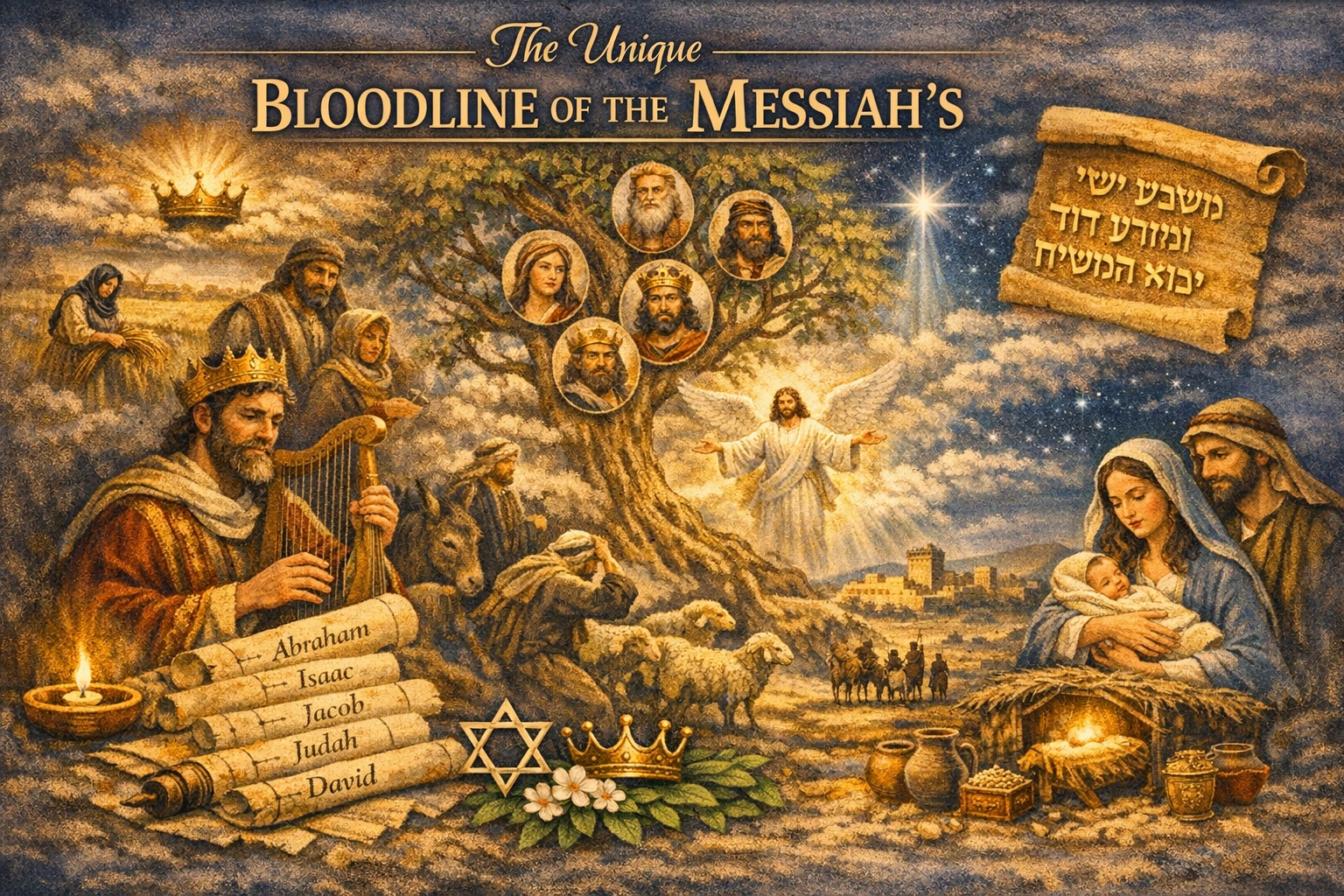
Week 3: The Unique Bloodline of the Messiah
Week 3: The Unique Bloodline of the Messiah
Throughout history, genealogy has played a significant role in shaping destinies. From ancient times, the recording of family lines has offered more than just a record of ancestry - it has provided a sense of identity, belonging, and divine purpose. Lineage, especially in the context of the Bible, is not merely about tracing one’s heritage, but about understanding the unfolding of God’s intentions through generations. When it comes to the Messiah, the importance of His lineage is not just a matter of historical interest - it's a central aspect of God’s plan. The very foundation of the Messiah’s identity is built upon a carefully preserved and purposefully selected bloodline, demonstrating the intricate way in which God moves through history. Today, I want to share with you why the Messiah’s bloodline is so unique, how it was crafted over thousands of years, and what it means for us in our own journeys.
The Messiah could not be born from just any family. His arrival was to be the culmination of centuries of prophecy, hope, and anticipation. He had to be born of a woman, but not just any woman - a woman whose ancestry included many of the fathers of Israel. This wasn’t a coincidence or a random selection. It was a deliberate act by God, who painstakingly narrowed down the bloodline over generations, eliminating billions of people so that the Messiah’s identity would be unmistakable and His arrival would fulfil ancient prophecies. Through the stories of Abraham, Isaac, Jacob, Judah, and the great King David, the line was refined and preserved, sometimes against all odds. Even in moments of crisis - such as the exile or times when the royal line seemed to be in jeopardy - God intervened to ensure the continuation of this extraordinary lineage. The threads of prophecy and promise were woven through ordinary and extraordinary people alike, providing a living testimony to God’s faithfulness.
Consider the magnitude of this process: from Adam and Eve through Abraham, Isaac, Jacob, and the many patriarchs, God guided history so that the Messiah’s birth would be both miraculous and traceable. The genealogies recorded in the Old Testament - often overlooked - are actually a tapestry of God’s promises and actions, each name representing a story of faith, struggle, and redemption. God’s hand can be seen in the selection of Ruth, a Moabite woman who became the great-grandmother of David, and in the preservation of the line through times of spiritual darkness and national turmoil. This rare bloodline is evidence of God’s sovereignty and His attention to detail. Every step, every generation was part of a divine plan to bring hope and salvation to the world. The meticulous record-keeping and fulfilment of prophecy in the person of Jesus is nothing short of miraculous, confirming that God was at work across the ages for this very purpose.
What can we learn from the Messiah’s bloodline? Like the Messiah, each of us is part of a story much bigger than ourselves. You are not here by accident. Your family, your background, your experiences - they are all known and valued by God. Just as He orchestrated the Messiah’s lineage, He is weaving together the details of your life for a purpose. You may not always see how the pieces fit together, especially during challenging times or when the road seems uncertain. But if God can orchestrate centuries of history to bring about His promise, we can trust that our lives are also held in His hands. Embrace the truth that your story matters, that your existence is purposeful, and that you are part of God’s unfolding plan. Trust that your life has meaning and that you are part of God’s unfolding plan - every moment, every relationship, every circumstance is significant in His eyes.
The Messiah’s rare bloodline reminds us that God is in control, working through history and individuals to accomplish His purposes. The preservation and fulfilment of this unique lineage testify to a God who is both powerful and personal - one who cares about the details and who keeps His promises. Let’s celebrate the intentionality of God’s plans and embrace the truth that He is just as involved in our lives today as He was in the lives of those who came before us. May this encourage you to seek His purpose, trust in His timing, and live with the confidence that you are cherished by the same God who orchestrated the coming of the Messiah.
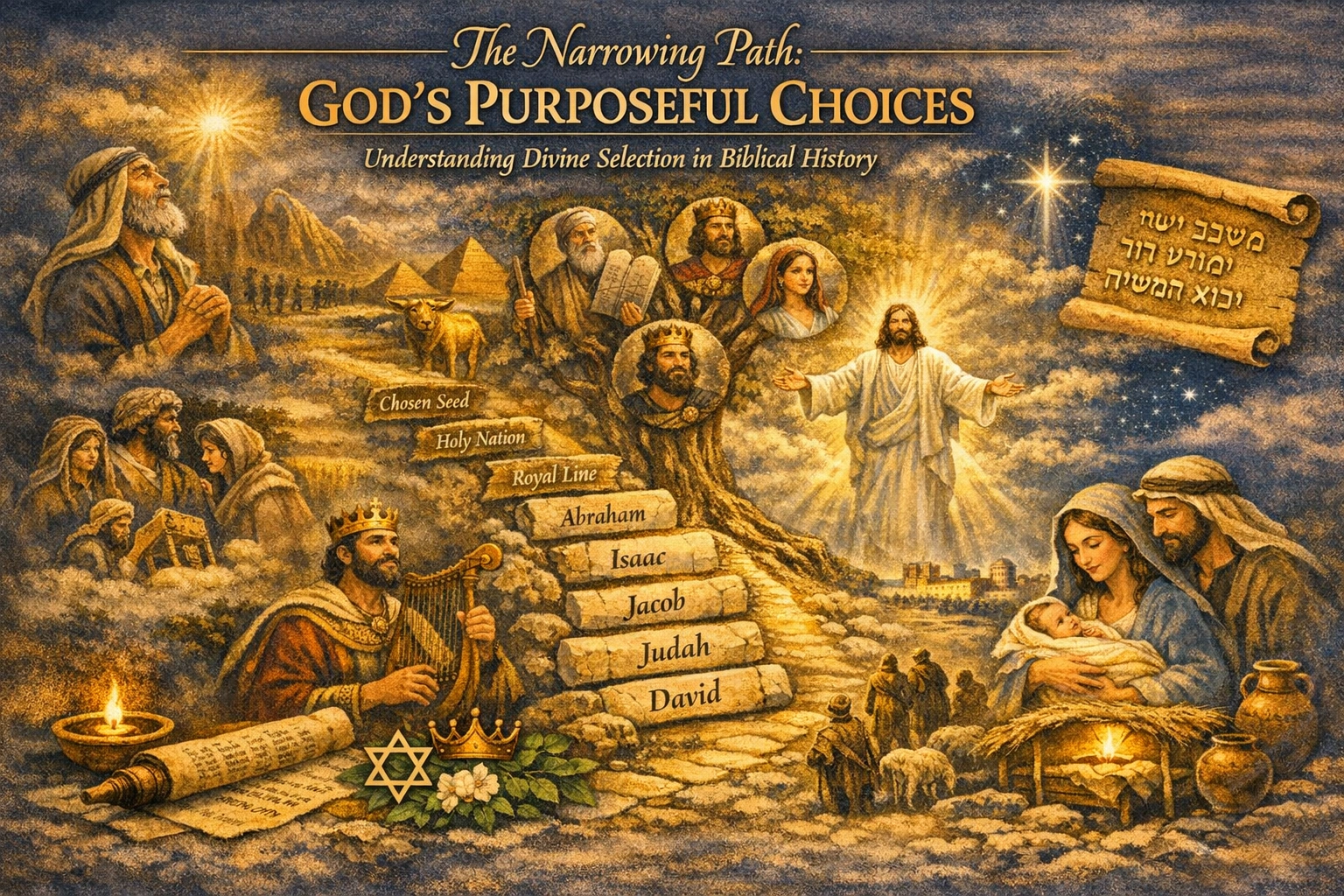
Week 4: The Narrowing Path: God’s Purposeful Choices
Week 4: The Narrowing Path: God’s Purposeful Choices
Have you ever pondered why some people are singled out for particular roles or responsibilities, while others seem to be overlooked? Throughout history, and especially within the pages of the Bible, we encounter numerous moments where God’s choices appear selective and sometimes even puzzling. Yet, these decisions are woven into a larger tapestry - a story where every thread, even those less visible, plays a vital part in the unfolding of God’s grand plan.
From Genesis to the writings of the prophets, the narrative of divine selection stands out as both a mystery and a comfort. God’s purposeful choices reveal a pattern: He does not act randomly, nor does He favour some without reason. Instead, each decision is part of a deliberate process, designed to fulfil promises and guide history towards redemption. The stories of Abraham, Isaac, Jacob, Judah, David, and others serve as examples of how the narrowing path of selection is not about exclusion, but about the refinement of purpose and the assurance that God’s plan always leads to good for those who trust in Him.
Right from the aftermath of the flood, when humanity began anew through Noah’s three sons, Shem, Ham, and Japheth, the path for God’s covenant people began to narrow. Out of all the branches of these families, God chose Abraham, a descendant of Shem, to be the bearer of His promise. This selection wasn’t just about Abraham himself - it set in motion a heritage of faith, blessing, and responsibility that would ripple through generations.
Abraham’s story highlights the intentional nature of God’s choices. Although Abraham had two sons - Isaac and Ishmael - God’s covenant was established specifically through Isaac. This act of selection halved Abraham’s immediate lineage, focusing the promise on one line. The narrowing continued with Isaac, who also had two sons, Jacob and Esau. Once again, God chose Jacob, whose descendants became the twelve tribes of Israel. However, even among Jacob’s sons, only Judah’s lineage was set apart for the royal and Messianic promise, creating a further refinement of God’s chosen path.
Centuries later, the prophet Isaiah declared that the Messiah would arise from the family of David - a descendant of Judah. Isaiah’s prophecy described the coming Saviour as a “root out of Jesse,” Jesse being David’s father. With each generation, the pathway narrowed, focusing not just on a family, but on individuals whose lives would shape the destiny of God’s people.
It’s natural to sometimes feel sidelined or insignificant, especially when we witness others being chosen for roles or opportunities that seem more important or visible. The pattern of divine selection throughout biblical history teaches us that God’s choices aren’t based on human standards of popularity or prestige. Rather, His selection is rooted in purpose - every person chosen, whether for a prominent task or a quiet role, is part of a larger story.
Instead of comparing ourselves with others, we can shift our focus to faithfulness in the places God has put us. God values faithfulness above visibility, and often the most significant contributions are made by those working behind the scenes. When God’s choices seem exclusive or difficult to understand, we are invited to trust in His wisdom and love, knowing that His plan is ultimately for the benefit of all who love Him and are called according to His purpose.
Ask yourself: How can I serve faithfully in my current circumstances? What opportunities has God given me to demonstrate His love and grace? By embracing our unique roles, whether large or small, we participate in God’s ongoing work in the world.
The story of God’s narrowing path - from Noah to Abraham, Isaac, Jacob, Judah, and David - reminds us that divine selection is purposeful and always motivated by love and grace. Even when we feel uncertain or left out, we can be confident that God’s choices are never arbitrary. Each one of us has a place in God’s unfolding story, a role to play that is both intentional and significant.
May we find strength and confidence in God’s sovereign selection, trusting that He knows us intimately and has a plan uniquely suited for each of our lives. Let us be faithful, available, and willing to follow wherever He leads, knowing that our part - big or small - contributes to the greater purpose God is bringing to fulfilment.
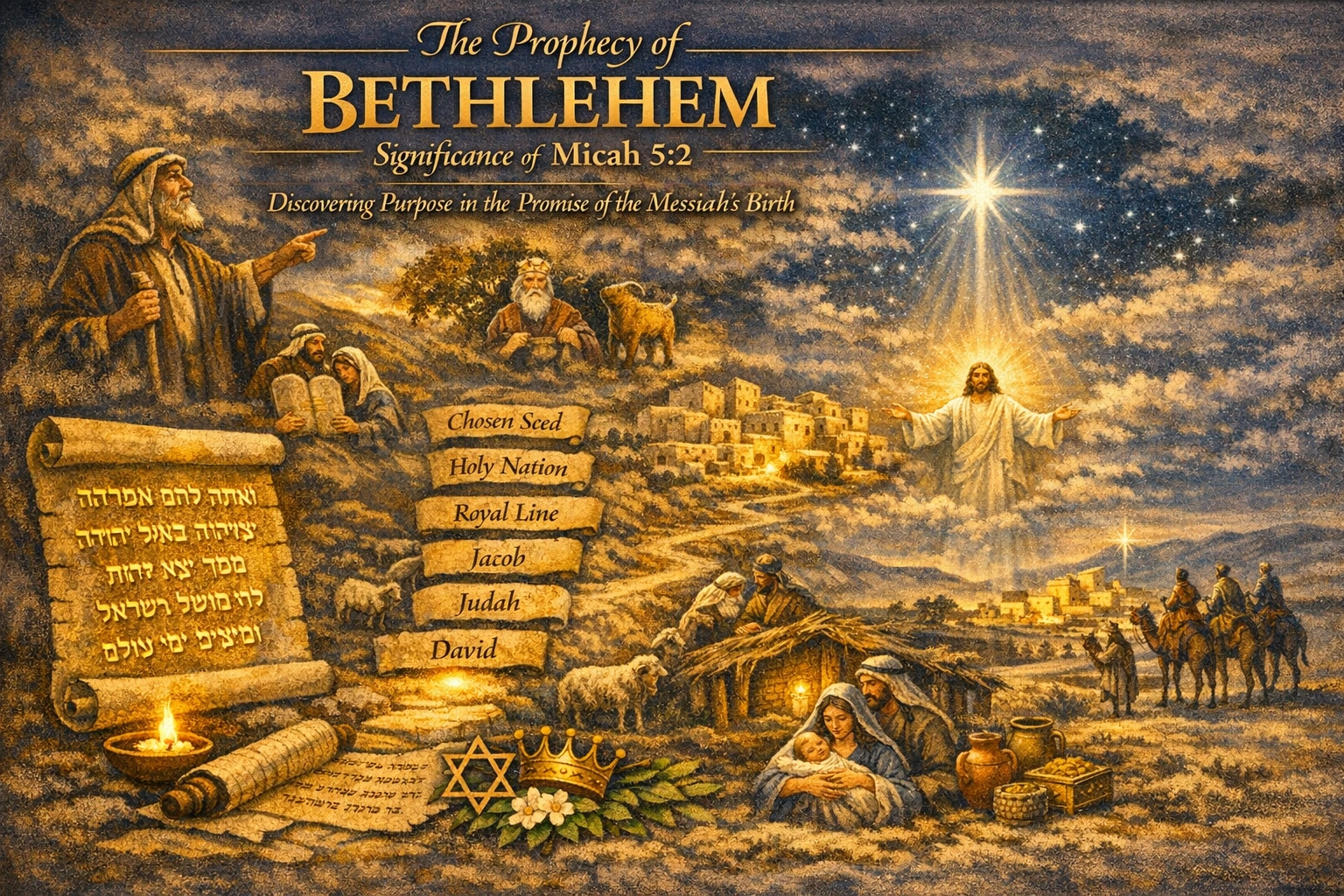
Week 5: The Prophecy of Bethlehem: Significance of Micah 5:2 Discovering Purpose in the Promise of the Messiah's Birth
Week 5: The Prophecy of Bethlehem: Significance of Micah 5:2 Discovering Purpose in the Promise of the Messiah's Birth
Today, I invite you to reflect with me on a profound Old Testament prophecy—Micah 5:2. This remarkable verse holds deep significance for both history and our personal journeys, as it pinpoints the birthplace of the Messiah, shaping the faith and hope of generations.
Let’s look at the verse: “But you, Bethlehem Ephrathah, though you are little among the thousands of Judah, yet out of you shall come forth to Me the One to be ruler in Israel, whose goings forth are from of old, from everlasting.”
Centuries before Jesus’ birth, Micah boldly identified Bethlehem—a small, unassuming town—as the chosen site for the Messiah’s arrival. This prophecy is extraordinary, not just for its accuracy but for highlighting God’s pattern of working through unexpected means and places. Instead of a grand city, God selects a humble township, “little among the thousands of Judah.”
This theme is woven throughout Scripture: God often uses people and places the world may overlook to achieve His greatest works. David, the shepherd boy who became king, and Mary, a young woman from Nazareth, illustrate how God’s plans unfold through the ordinary. This challenges us to remember that God’s perspective is vastly different from ours.
Bethlehem at the time was neither renowned nor influential. Though it was the city of David, its significance had faded. Yet, in God’s plan, it became the birthplace of the Saviour. This reminds us that significance in God’s eyes is not measured by size, fame, or recognition. God delights in using the overlooked to fulfil His extraordinary purposes.
This principle is echoed throughout the Bible and often in our own lives. Moments of transformation and blessing rarely come from prominence or pride, but rather from times of humility, waiting, or seeming insignificance. God’s strength is made perfect in weakness, and His glory shines in unexpected places.
Perhaps you sometimes feel insignificant, overlooked, or unimportant—in your job, family, or community. Micah’s prophecy encourages us: God sees beyond appearances and status. He chooses people and places for His divine plans based on His purposes, not the world’s standards.
Just as Bethlehem was chosen for the Messiah’s birth, your life—however ordinary it may seem—can be a vessel for God’s purpose. Your story, struggles, and small acts of kindness can have a ripple effect beyond what you imagine. God is not limited by our limitations; He specialises in using them for His glory.
Where in your life do you feel “small” or insignificant? In those very places, trust that God can bring about something meaningful and lasting. Don’t underestimate what God can do through your life, relationships, work, or community. Often, it’s in the quiet, uncelebrated moments that God does His most profound work.
The Messiah’s birth in Bethlehem was not random, but a deliberate fulfilment of promise. Likewise, your life is not an accident. God’s plans for you are intentional, loving, and good—even if you can’t always see the bigger picture.
This prophecy also delivers a broader message of hope and assurance. In a world that measures worth by achievement or popularity, Micah 5:2 calls us back to a different standard: God’s purpose and promise. It reassures us of God’s perfect timing and the trustworthiness of His promises, even if their fulfilment takes years or generations.
If you feel discouraged by slow progress or unnoticed efforts, Micah reminds us that God is always at work behind the scenes. He weaves together the threads of history and our own stories in ways we may not fully understand. We can cling to hope, knowing that God’s word never returns void, and His promises, no matter how improbable, will come to pass.
Micah 5:2 is more than a prediction—it’s a source of comfort, encouragement, and challenge. God’s promise was fulfilled in the most unexpected place, showing us that greatness often comes from humility. Let’s embrace the truth that our worth is determined by God’s purpose, not worldly measures.
Like Bethlehem, we’re called to make room in our hearts and lives for God’s work, trusting He can bring something eternal and impactful from the smallest beginnings. May we be open to God’s purpose, attentive to His call, and confident that, through Him, our ordinary lives can become part of an extraordinary story.
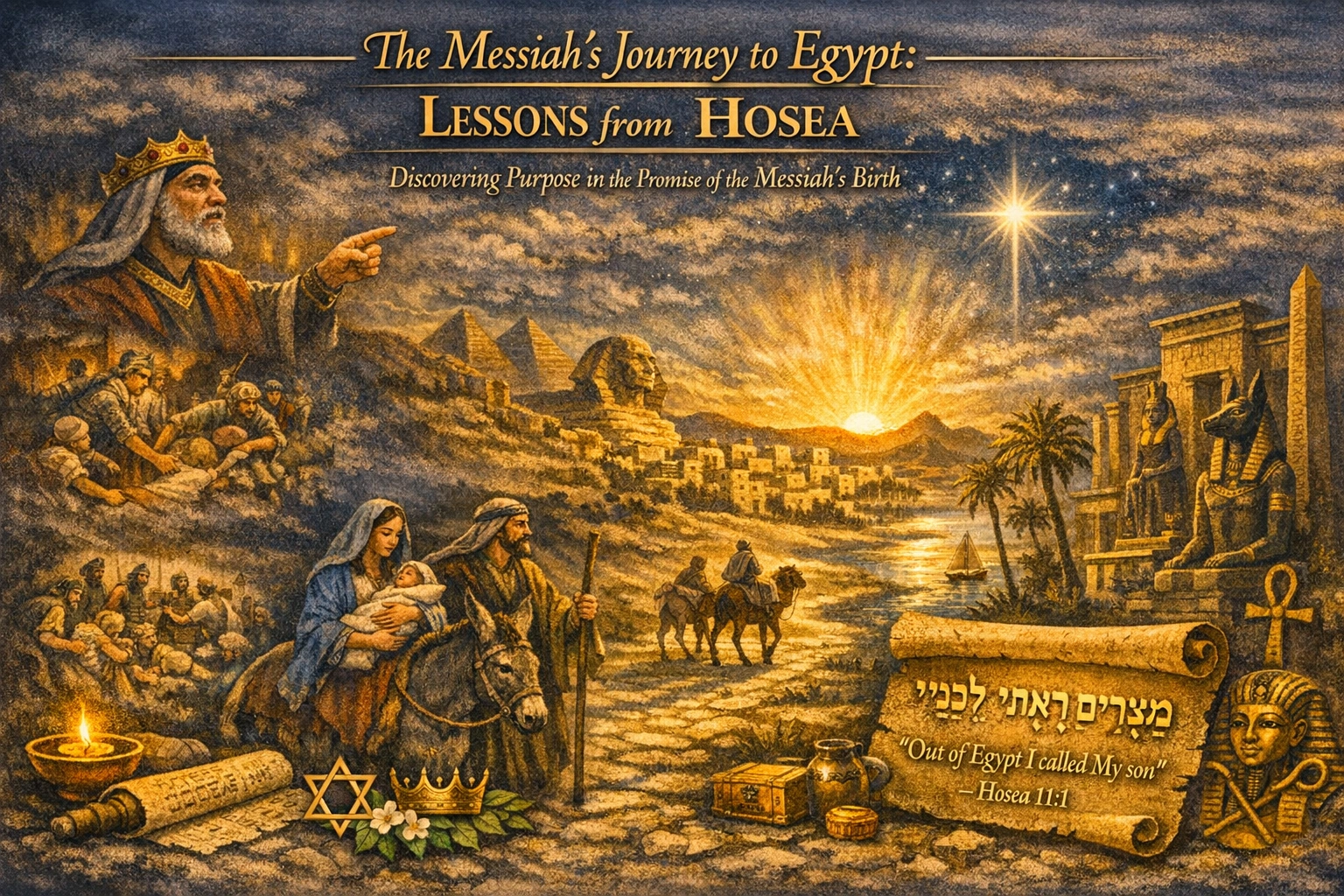
Week 6: The Messiah’s Journey to Egypt: Lessons from Hosea
Week 6: The Messiah’s Journey to Egypt: Lessons from Hosea
Let's take a deeper look at a truly remarkable moment in the life of the Messiah, one that is woven into the fabric of both the Old and New Testaments. The prophet Hosea, in Hosea 11:1, declares, “Out of Egypt I will call Him.” On the surface, these words might seem simple, but they point us to a rich and significant event: as a young child, the Messiah would travel to Egypt, and from that foreign land, God would call Him back to His people. This journey is not just a matter of historical fact but a profound demonstration of God’s faithfulness and purpose, even when the path leads through unexpected places.
To truly understand the weight of Hosea’s words, we need to consider their original context. Hosea spoke during a turbulent time in Israel’s history, and his prophecy first referred to the nation of Israel itself. The Israelites had been slaves in Egypt, oppressed and afflicted, until God, in His mercy, delivered them through the Exodus. Hosea’s statement, “Out of Egypt I called My son,” recalls that dramatic rescue and the special relationship God had with His people.
However, in the New Testament, this prophecy gains a new layer of significance. After the birth of Jesus, King Herod’s jealousy and fear led to a deadly threat against the newborn Messiah. To escape Herod’s wrath, Joseph and Mary fled with their son Jesus to Egypt - a land that, for centuries, had been seen as a place of bondage and hardship for Israel. The Gospel of Matthew (Matthew 2:15) draws a direct connection between Jesus’ time in Egypt and Hosea’s prophecy, showing that even this detour was part of God’s intricate plan. What was once a collective memory for the nation of Israel becomes, in Jesus, a personal journey that fulfills God’s promises in a new way.
This raises a powerful question: why would God send His own Son to Egypt, a land synonymous with suffering and oppression? Egypt symbolised everything the Israelites wanted to leave behind, yet it became a sanctuary for the Messiah at a most vulnerable time. This paradox teaches us that God’s purposes often unfold in the very places we least expect.
Sometimes, God leads us into situations or places that seem counterintuitive or even daunting. Just as Egypt was a place of safety for Jesus, so too can our own “Egypts” - the difficult, unfamiliar, or uncomfortable seasons of life - become part of God’s good plan for us. Even when we cannot see the reason, God is at work, orchestrating events for our protection, growth, and preparation. The Messiah’s journey challenges us to reconsider our assumptions about where God’s blessings can be found and to trust that His wisdom far exceeds our understanding.
Each of us will encounter times when life’s path leads us to our own Egypt - moments filled with uncertainty, setbacks, or transitions that feel uncomfortable and out of our control. You may be waiting for a breakthrough, facing a loss, or moving through a season that feels barren or confusing. In those moments, the story of the Messiah’s journey to and from Egypt offers comfort and hope.
Even in places that seem far from where we want to be, God is present. His guidance doesn’t always look like what we expect, but it never fails. The detours and delays, the trials and challenges, can all become opportunities for God to protect us, shape our character, and prepare us for what lies ahead. He may be using your current situation to develop resilience, deepen your faith, or position you for a purpose you haven’t yet imagined. The key is to trust that He is with us, even when the way forward is unclear.
As we reflect on Hosea’s prophecy and the Messiah’s journey, let’s be reminded that God’s plans often unfold in ways that defy our expectations. Just as God called His Son out of Egypt, so He calls each of us out of our own seasons of uncertainty and transition. Our task is to listen for His voice, follow His leading, and trust that every step - even those through “Egypt” - are part of His greater story for our lives.
When you find yourself in an unexpected place, remember: God is not absent. He is working behind the scenes, guiding, protecting, and preparing you for the next chapter. Out of every season, He calls us - just as He called His Son. Let’s be prepared to listen, to follow, and to trust in His unwavering and faithful guidance, believing that even in the most unlikely places, His purpose will prevail.
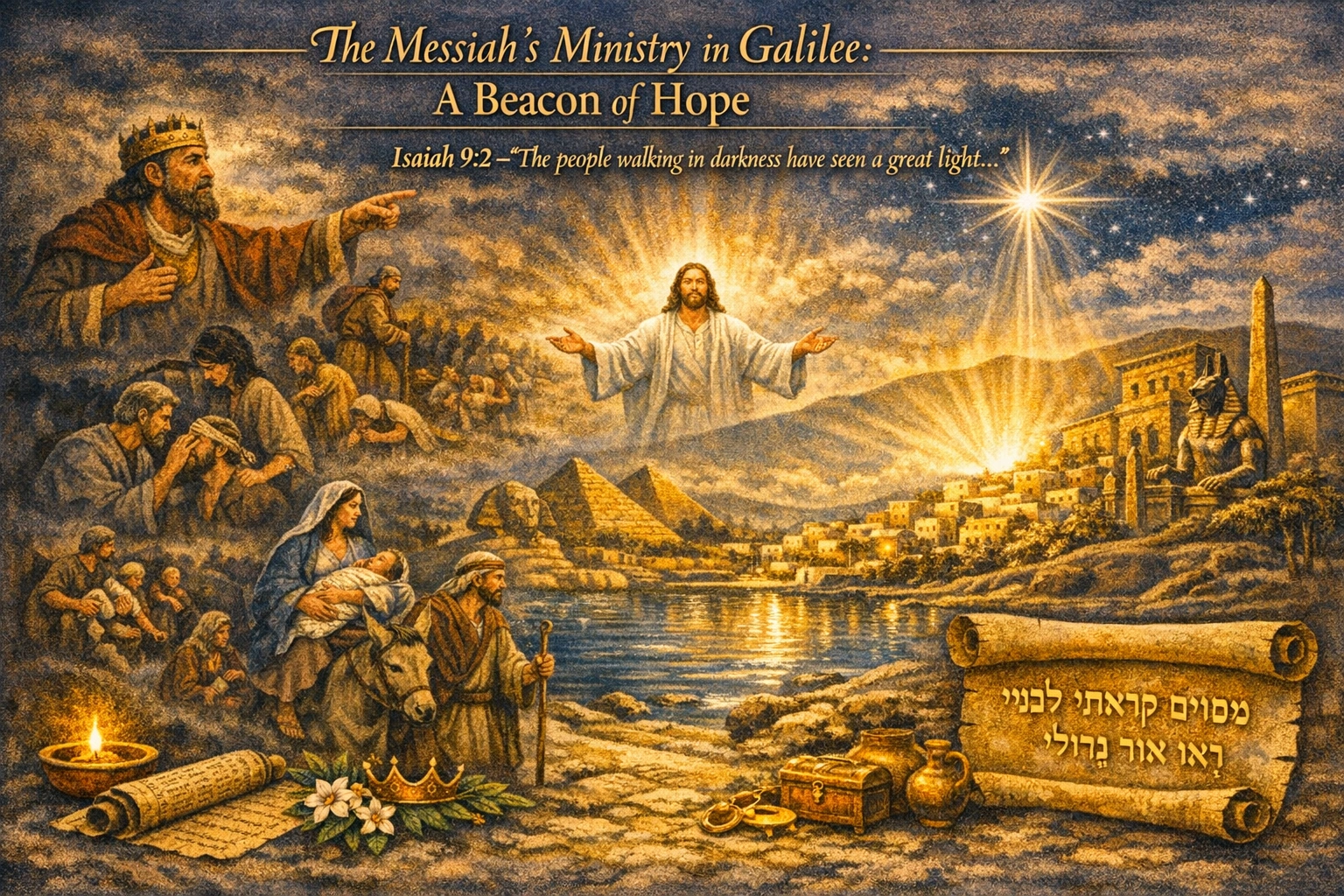
Week 7: The Messiah’s Ministry in Galilee: A Beacon of Hope
Week 7: The Messiah’s Ministry in Galilee: A Beacon of Hope
Today, I’d like to share a deeper reflection on a powerful prophecy found in Isaiah 9:2: “The people who walked in darkness have seen a great light; those who dwelt in the land of deep darkness, on them has light shined.” This verse not only foretells that the Messiah’s ministry would centre primarily in Galilee, a region not typically associated with spiritual significance in ancient Israel, but it also carries a profound message for each of us. Let’s explore the historical context, the spiritual implications, and the personal relevance of this prophecy.
In biblical times, Galilee was regarded as an outlying, somewhat overlooked region. It wasn’t the religious centre - Jerusalem held that distinction, being the site of the temple and the heart of Jewish worship. Galilee, by contrast, was distant from the seat of religious authority and was home to a diverse population, including many Gentiles. Its reputation was mixed, often seen as a place of spiritual “darkness” and social marginalisation.
Yet Isaiah’s prophecy flips this perception on its head. He foretells that the Messiah would shine His light most brightly in Galilee. When Jesus began His ministry, He fulfilled this prophecy by living, teaching, healing, and performing miracles among the people there. Jesus called His disciples from Galilee, preached the Sermon on the Mount nearby, and walked on the waters of the Sea of Galilee. These acts were not random; they were purposeful, demonstrating that God’s love and purpose reach those who feel forgotten, marginalised, or distant from conventional centres of power and influence.
Isaiah uses the imagery of light piercing darkness to describe the impact of the Messiah’s work. The darkness symbolises not only spiritual blindness or despair but also the reality of life’s hardships and uncertainties. Galilee, known for its spiritual and social “darkness,” became the stage for the dawn of hope and salvation. Jesus’ ministry brought healing, meaning, and redemption where many least expected it. In Matthew 4:13-16, we see this prophecy fulfilled as Jesus settles in Capernaum, Galilee, bringing hope and restoration to the region.
This transformation in Galilee reminds us that no place is too remote, no person too forgotten, for God’s light to break through. The physical and spiritual healing that Jesus brought to Galilee is a powerful testament to God’s intention to reach every corner of humanity, including those places and people often dismissed by society.
What does this mean for us today? We all have “Galilees” - areas of our lives or communities that feel overlooked, forgotten, or weighed down by darkness. These might be personal struggles, feelings of insignificance, broken relationships, or even entire neighbourhoods or groups who feel marginalised. Isaiah’s prophecy reminds us that God does not overlook these places. Just as Jesus brought light to Galilee, He is present and active in the parts of our lives we may feel are unimportant, hopeless, or overshadowed by adversity.
We are invited to seek His light in our own “Galilees,” trusting that no place or person is beyond His reach. Sometimes, the greatest transformations occur where hope seems least likely. By recognising the “Galilees” in our world - whether in our families, workplaces, or communities - and intentionally bringing light, kindness, and compassion, we participate in the ongoing work of the Messiah. It’s a call to not only receive God’s light but also to become bearers of light to others.
· Personal Reflection: Take time this week to identify areas in your life that might feel like Galilee - overlooked, unimportant, or shrouded in darkness. Invite God’s light into these places.
· Community Engagement: Consider those in your community who might feel excluded or neglected. How can you extend kindness, friendship, or support to them?
· Hope and Encouragement: Remember, the light shines brightest in the darkest places. Be encouraged that God is at work even when things seem bleak or uncertain.
In closing, Isaiah 9:2 teaches us that the Messiah’s ministry was not reserved for the privileged or powerful, but for the ordinary and overlooked. Galilee became a symbol of hope and transformation - proof that God’s love often shines brightest where it’s needed most. As we go into the week ahead, let’s carry this message with us, remembering to look for and bring light into the “Galilees” around us. Whether it’s an encouraging word, a helping hand, or simply being present with someone in their time of need, we can reflect the hope and light that Jesus brought to Galilee.
May we all be inspired to see the world through the eyes of hope, knowing that God’s love is not limited by geography, status, or circumstance, but is available to all - especially to those who walk in darkness. Let us be bearers of that light, and continue the legacy of the Messiah’s ministry in Galilee in our own lives.
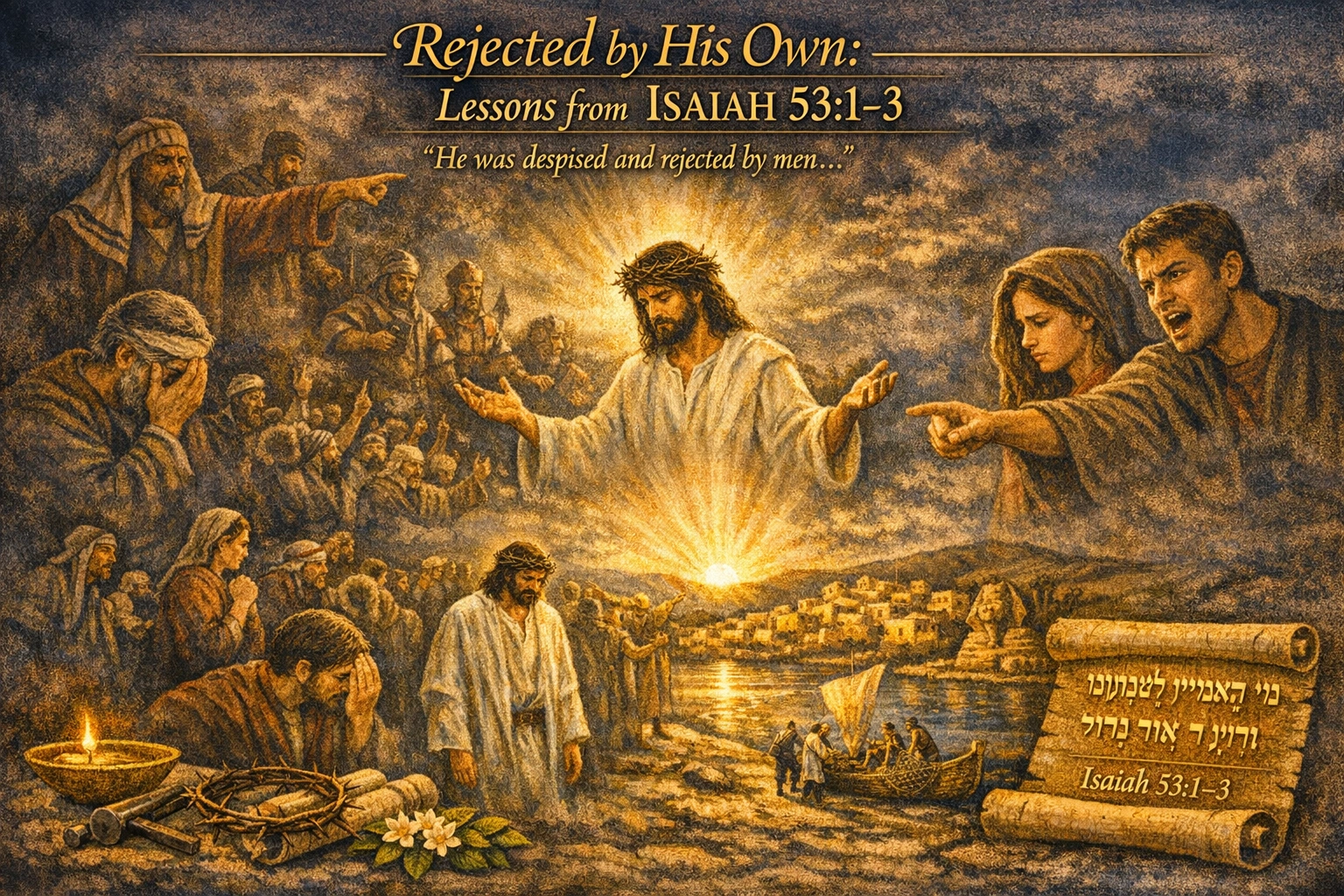
Week 8: Rejected by His Own: Lessons from Isaiah 53:1-3
Week 8: Rejected by His Own: Lessons from Isaiah 53:1-3
Isaiah 53:1-3 offers a powerful and moving prophecy about a coming Messiah who would be rejected by His own people: “He will be rejected by His own people.” Throughout centuries, believers and scholars alike have recognised this passage as one of the most vivid and direct Old Testament predictions of the suffering and rejection Jesus would endure. The words of Isaiah echo across time, reminding us that even the most righteous, loving, and compassionate individuals may face misunderstanding, exclusion, and rejection. This prophecy not only points ahead to Jesus but also resonates with anyone who has ever faced the pain of feeling cast aside or misunderstood.
Imagine the profound pain and disappointment of being rejected by those closest to you - your family, your community, and your friends. For Jesus, this was not merely a hypothetical scenario, but a lived reality. Isaiah describes Him as “despised and rejected by men; a man of sorrows and acquainted with grief.” These words paint a picture of someone who knows the depths of human suffering and loneliness. Despite bringing hope, healing, and truth to those around Him, Jesus was not welcomed or embraced by many who should have recognised Him as the fulfilment of their deepest hopes. The Messiah’s experience reminds us that standing up for what is right, truthful, or loving often comes at a cost. Rejection, in this sense, becomes not just a personal burden but a signpost pointing to a higher purpose and calling.
Consider the moments when you have felt excluded or misunderstood - at work, at school, or even within your own circle of family and friends. It is a universal human experience to long for acceptance and belonging, and yet, like Jesus, we may be met with indifference or hostility. The reality of rejection can leave us feeling isolated, discouraged, and uncertain about our value or purpose. However, Isaiah’s prophecy assures us that such experiences are not meaningless; rather, they are woven into the very fabric of spiritual growth and transformation.
Rejection is not unique to Jesus; it is a part of the human condition. Each of us, at one point or another, will face moments where our contributions, beliefs, or identity are not valued by others. The example of Jesus offers a compelling challenge: to respond with grace, perseverance, and love. Instead of allowing bitterness, resentment, or retaliation to take root, we are invited to follow Christ’s model - one marked by forgiveness, compassion, and unwavering commitment to His purpose.
When faced with rejection, consider asking yourself: How can I show love in this situation? How can I remain true to my calling, even when others do not understand or accept me? Jesus’ response was not to retreat or lash out, but to continue serving, loving, and forgiving - even those who wronged Him. This attitude transforms rejection from a stumbling block into an opportunity for growth, maturity, and deeper faith. By choosing to respond with grace, you not only preserve your own integrity but also create space for reconciliation and healing in your relationships.
It’s important to remember that responding with grace does not mean ignoring hurt or pretending that rejection doesn’t matter. Acknowledging your feelings, seeking support from trusted friends or mentors, and leaning into prayer can help you process your experience and find strength to move forward. The story of Jesus assures us that we are never alone in our struggles; God understands our pain and walks alongside us, offering comfort and hope.
Isaiah’s prophecy serves as a reminder that rejection does not define your worth, your identity, or your future. The story of Jesus reveals that God can use even the most painful and challenging moments for a greater purpose. If you are feeling rejected today, take heart in knowing that you are in good company - and that your pain is seen and known by a compassionate God.
Lean into your faith, stand firm in your purpose, and let God’s love guide your actions and attitudes. Just as Jesus was ultimately vindicated and exalted, your journey can also be one of hope, transformation, and renewal. The rejection you face today may become the foundation for deeper relationships, greater resilience, and a more profound understanding of your calling. In the end, the message of Isaiah 53:1-3 is not merely one of sorrow, but of hope - hope that transcends rejection and leads to redemption.
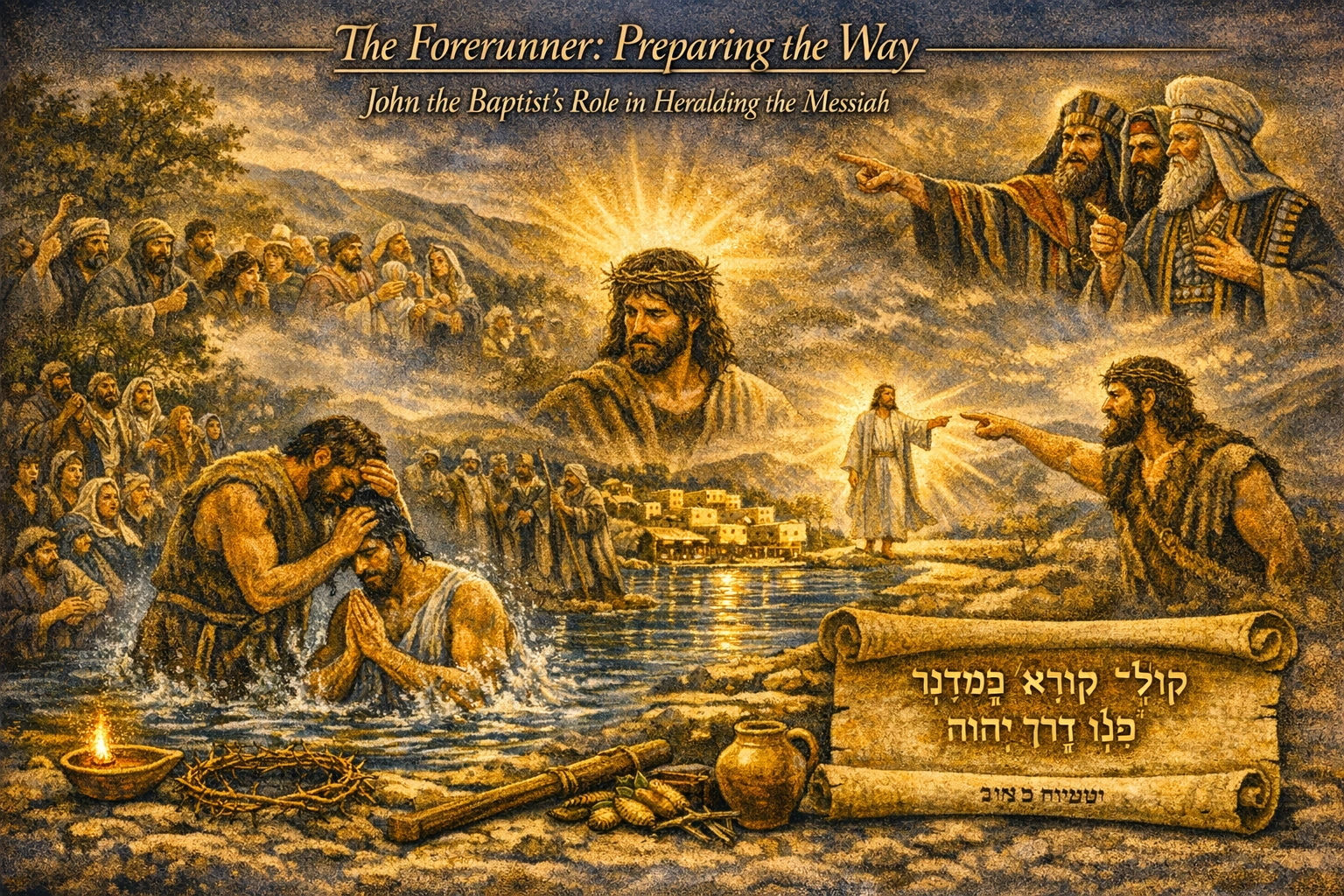
Week 9: The Forerunner: Preparing the Way
Week 9: The Forerunner: Preparing the Way
The theme of a forerunner—a messenger who prepares the way for someone greater—is a thread that runs deeply through biblical prophecy and narrative. Rooted in the Old Testament, prophets such as Isaiah and Malachi vividly foretold the arrival of a figure whose mission was to make ready both the physical and spiritual landscape for God’s coming work. Isaiah’s words, “A voice of one calling: ‘In the wilderness prepare the way for the Lord; make straight in the desert a highway for our God,’” (Isaiah 40:3) and Malachi’s declaration, “I will send my messenger, who will prepare the way before me,” (Malachi 3:1) reflect a divine plan where anticipation and preparation are essential. These passages speak of more than just surface readiness—they call for deep spiritual openness and genuine transformation.
Delving into the biblical narrative, the role of the forerunner is far more than ceremonial. This figure is tasked with preparing people’s hearts and minds for what lies ahead. In the New Testament, John the Baptist is recognised as the fulfilment of these ancient prophecies. His ministry was defined by a fervent call to repentance, compelling people to turn from their old ways and return to God as they awaited the promised Messiah. John’s message was not about superficial change; it demanded true repentance, the acknowledgement of one’s need for forgiveness, and a willingness to be transformed.
John the Baptist’s life was a clear and powerful witness to the prophecies spoken centuries before his birth. He lived a life marked by simplicity and humility—dressing in camel’s hair and surviving on locusts and wild honey—to emphasise his dedication to his calling rather than to worldly comforts. More importantly, John’s humility stood out; despite gathering his own following, he always pointed people to Jesus rather than to himself, famously saying, “He must become greater; I must become less” (John 3:30). John’s actions and words exemplified the genuine qualities of a forerunner: removing obstacles, challenging complacency, and ensuring that the path was clear for the work of God to advance. His unwavering commitment serves as a reminder that real preparation sometimes means stepping aside so that someone greater can take the lead.
The message and mission of the forerunner is not merely a historical concept; it remains a living challenge for every generation. Like John the Baptist, we are also called to prepare the way for God’s work—in our own hearts, within our families, at work, and in our communities. This kind of preparation takes many forms. It could mean living with integrity and honesty so that our actions reflect our beliefs, encouraging and uplifting those around us, or helping others to overcome the obstacles and doubts that hinder faith.
Being a forerunner today means pointing others towards hope, offering forgiveness, and showing love in practical, everyday ways. Sometimes, it involves the courage to stand up for what is right, even when it’s unpopular or difficult. At other times, it’s about quietly supporting someone in need or making sacrifices to ensure others have the opportunity to thrive. Ultimately, the calling of the forerunner is about creating space—space for God’s love, truth, and grace to enter and transform lives.
This call invites each of us to reflect: How can we prepare the way for God in our relationships? Are there barriers of pride, resentment, or fear that need to be addressed in our own lives? What can we do to help others experience God’s presence more clearly? By contemplating these questions, we begin to see the everyday opportunities to act as modern-day forerunners, paving the way for God’s work in both significant and subtle ways.
In conclusion, the prophecy that “He will be preceded by a forerunner” is more than a historical detail—it’s an ongoing reminder that God often prepares us for the important things He wants to accomplish, both individually and collectively. Throughout history, God has used ordinary people, often with doubts and weaknesses, to be forerunners who help clear the way for His plans. Whether in the era of the prophets, in the days of John the Baptist, or in our own time, the call remains consistent: to be open, responsive, and willing to prepare ourselves and those around us for God’s movement.
Let’s take up this calling wholeheartedly. By choosing to be forerunners, we become part of God’s ongoing story—a narrative that brings hope, renewal, and transformation. As we prepare the way in our own lives and the lives of others, we make room for something greater: for God to work, to heal, and to change the course of our world. When God moves, may we be ready, not just to witness it, but to welcome it with open hearts and hands.
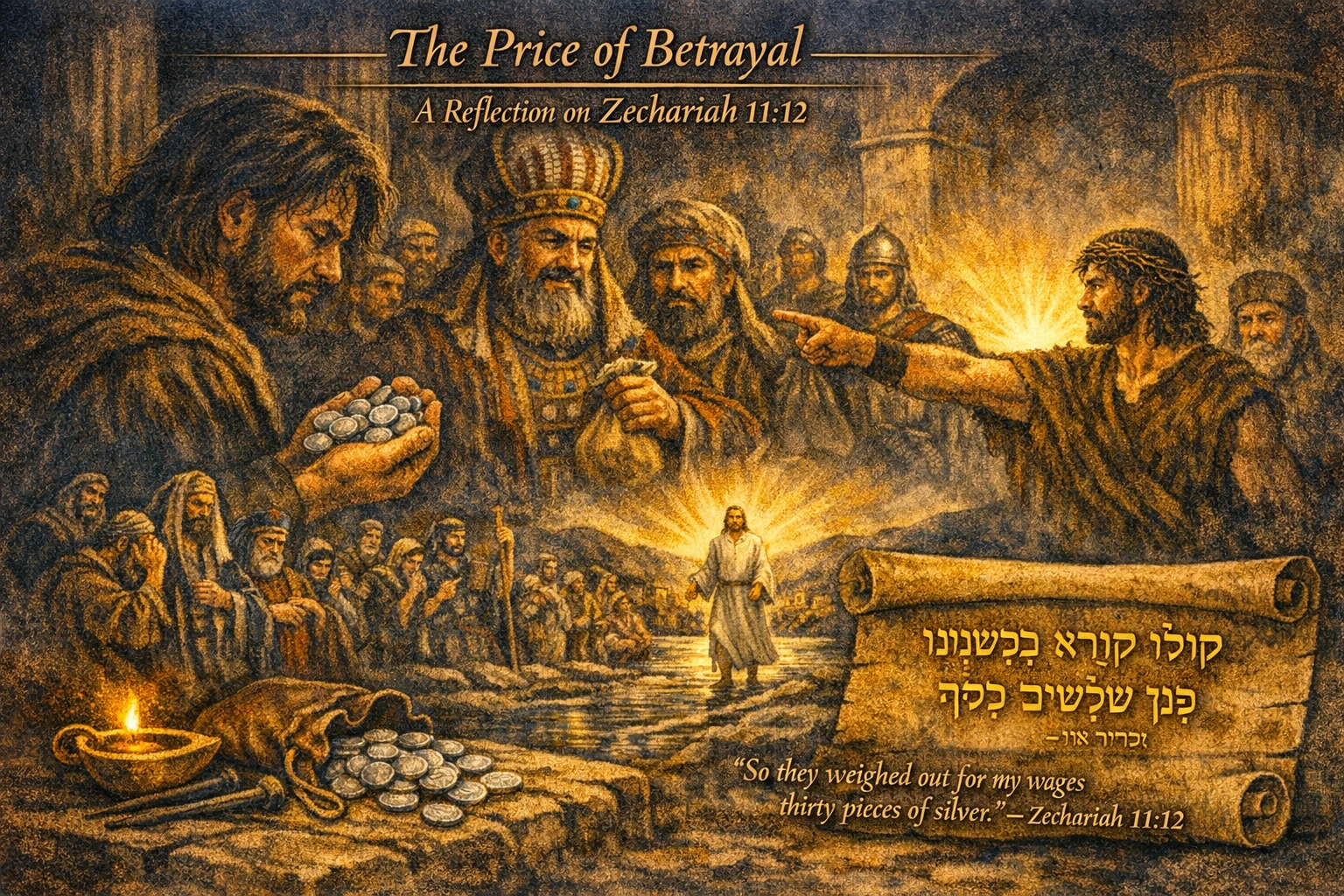
Week 10: The Price of Betrayal
Week 10: The Price of Betrayal
Zechariah 11:12 contains a brief but powerful prophecy: the coming Shepherd would be betrayed for “thirty pieces of silver.” Though simple on the surface, this statement reaches across centuries and finds its fulfilment in the betrayal of Jesus Christ. Yet the verse does more than predict a moment in history. It invites us to reflect on the nature of betrayal itself and the ease with which people can trade what is precious for something fleeting. The theme is timeless, challenging every generation to consider what we value and what we might be tempted to surrender for short‑term gain.
In the ancient world, thirty pieces of silver was the legal price of a slave. It was not a noble sum, but a figure that highlighted how cheaply a life could be valued. When Judas accepted this amount to betray Jesus, the prophecy was fulfilled with chilling precision. The transaction exposes how trust, loyalty, and friendship can be reduced to mere currency. It also mirrors a broader human tendency: the temptation to undervalue what truly matters. Whether in relationships, workplaces, or personal decisions, the lure of quick reward can lead us to compromise integrity for something that ultimately proves hollow.
The prophecy’s shock lies in its bluntness. The worth of a person — their dignity, trust, and relationship — is immeasurable, yet here it is exchanged for the cost of a slave. This contrast urges us to examine the “transactions” in our own lives. We may not handle silver coins, but we face choices that test our loyalty and honesty. The “thirty pieces of silver” can appear as popularity, financial shortcuts, social advantage, or the desire to avoid discomfort. Betrayal often disguises itself as opportunity, offering temporary benefits while quietly eroding character.
The lesson from Zechariah is both ancient and urgently relevant: do not allow short‑term gain to outweigh long‑term integrity. Ask yourself what your price might be, and whether you are valuing people and principles as you should. These questions are not always comfortable, but they are essential. Each day presents moments where we must choose between convenience and conviction. By committing to honour our values even when it costs us, we become people who cannot be bought.
Guarding integrity requires vigilance. Betrayal rarely arrives dramatically; it often begins with small compromises, quiet excuses, or subtle self‑interest. Recognising the many forms that “thirty pieces of silver” can take helps us resist them. In families, friendships, workplaces, and communities, loyalty is strengthened when we keep our word and stand by others even when it is difficult. Such faithfulness builds trust that lasts far longer than any temporary reward.
The prophecy of the thirty pieces of silver ultimately calls us to look inward. Are we protecting what matters most, or trading it away for something that will not last? The fulfilment of Zechariah’s words in the betrayal of Jesus reminds us that integrity is priceless. When we choose honour over convenience, we reflect the character God desires and uphold the trust others place in us.
As we reflect on this passage, we are encouraged to value relationships, guard our integrity, and resist the temptations that would compromise our character. The true cost of betrayal is not measured in coins but in the loss of trust and the damage done to what is precious. By choosing loyalty, honesty, and faithfulness, we become people whose lives demonstrate that some things are far too valuable to ever be sold.
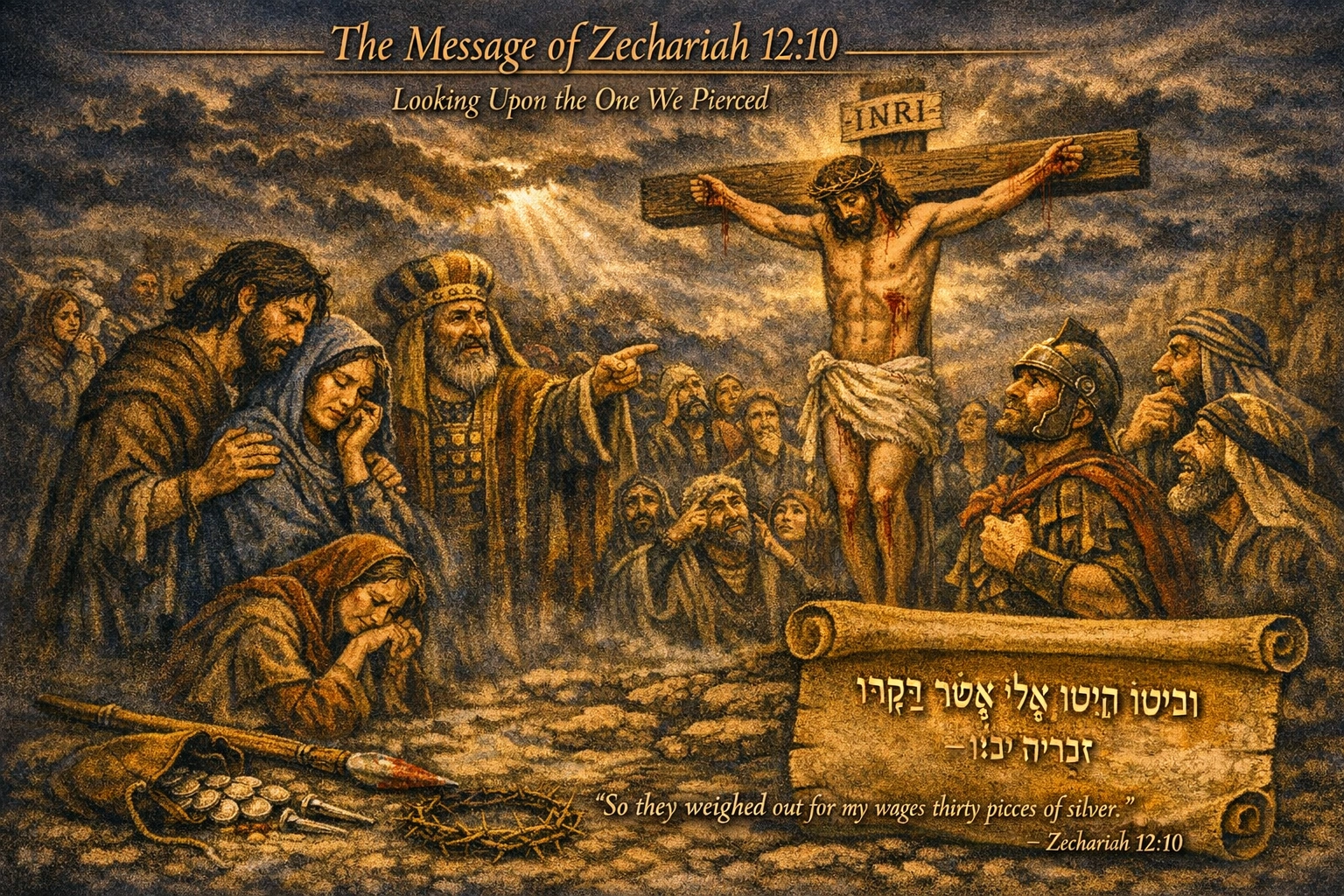
Week 11: The Message of Zechariah 12:10: Looking Upon the One We Pierced
Week 11: The Message of Zechariah 12:10: Looking Upon the One We Pierced
Today, I want to share a more detailed reflection on a powerful verse from the Old Testament, Zechariah 12:10: "They will look upon the One whom they pierced." This short phrase carries a profound message about prophecy, repentance, and hope - one that continues to resonate deeply in our lives today. Zechariah’s words invite us not only to consider the historical significance of this prophecy, but also to explore its personal meaning for each of us in the present day.
Zechariah was a prophet ministering to the people of Israel during a period marked by uncertainty, disappointment, and the difficult work of rebuilding after exile. His messages often offered encouragement and reminded the people of God’s continuing presence and promises, even in times of hardship. In Zechariah 12:10, he paints a vivid scene of a future moment when God's people would look upon someone they had pierced - a figure who would become the focal point of their grief and repentance.
This prophecy, while spoken centuries before Jesus, is believed by Christians to point directly to Christ and His crucifixion. The act of "piercing" carries both literal and symbolic meaning, referring not only to the nails driven into Jesus’ body, but also to the broader rejection and suffering He experienced on behalf of humanity. The verse connects the ancient longing for redemption with the fulfilment found in Jesus, bridging the gap between Old Testament anticipation and New Testament revelation.
The significance of Zechariah’s statement goes well beyond a historical prediction - it calls everyone to a moment of personal reflection and spiritual reckoning. "They will look upon the One whom they pierced" describes a collective awakening, a realisation of the consequences of turning away from God and the pain that can result from neglect and rebellion. This isn’t just a story from the past; it’s an ongoing invitation for each of us to examine how our own choices, attitudes, and actions can either draw us closer to God or contribute to His suffering.
For Christians, seeing Jesus as "the One whom they pierced" brings the story of the cross into sharper focus. It asks us to consider the depth of Christ’s love and the magnitude of His sacrifice - a love that endures even when we falter. In this sense, Zechariah’s prophecy encourages honest self-examination and a willingness to mourn not only the wounds inflicted on Christ, but also the brokenness within ourselves and our world. It’s a call to humility, repentance, and a renewed commitment to living in grace.
How does this ancient prophecy apply to us here and now? While none of us physically pierced Jesus, our everyday actions, words, and choices can sometimes reflect hearts that are distant or closed off to Him. Zechariah’s message challenges us to "look upon" the One we might have wounded through apathy, indifference, or outright rebellion. It’s a deeply personal call to pause, reflect, and confront the ways we may have caused harm - whether knowingly or unknowingly.
This process of looking within is not meant to lead to despair, but to hope and transformation. As we recognise our shortcomings, we are also invited to seek forgiveness and experience the renewing power of God’s love. The act of gazing upon the pierced One is both an acknowledgement of our need and a celebration of the healing and restoration that God offers. It’s about turning away from old patterns and embracing a new life shaped by grace, compassion, and a genuine desire to follow Christ more closely.
In practical terms, this might mean making amends with others, cultivating a spirit of humility, or simply spending more time in prayer and reflection. It’s about letting the reality of Christ’s sacrifice penetrate our hearts, moving us to respond with gratitude and a commitment to grow in faith.
In closing, Zechariah 12:10 stands as a powerful invitation to reflection, repentance, and renewal. By looking upon the One whom they pierced, we acknowledge not only our need for healing and forgiveness, but also the incredible hope that comes from God’s enduring love. This prophecy is a reminder to turn our hearts back to God, to accept His grace, and to let His love transform every aspect of our lives.
Let us never take for granted the gift of forgiveness and the hope that is found in Christ. May we approach each day with open eyes and open hearts, ready to respond to the call of Zechariah and the promise of restoration that lies at the heart of the Christian faith.
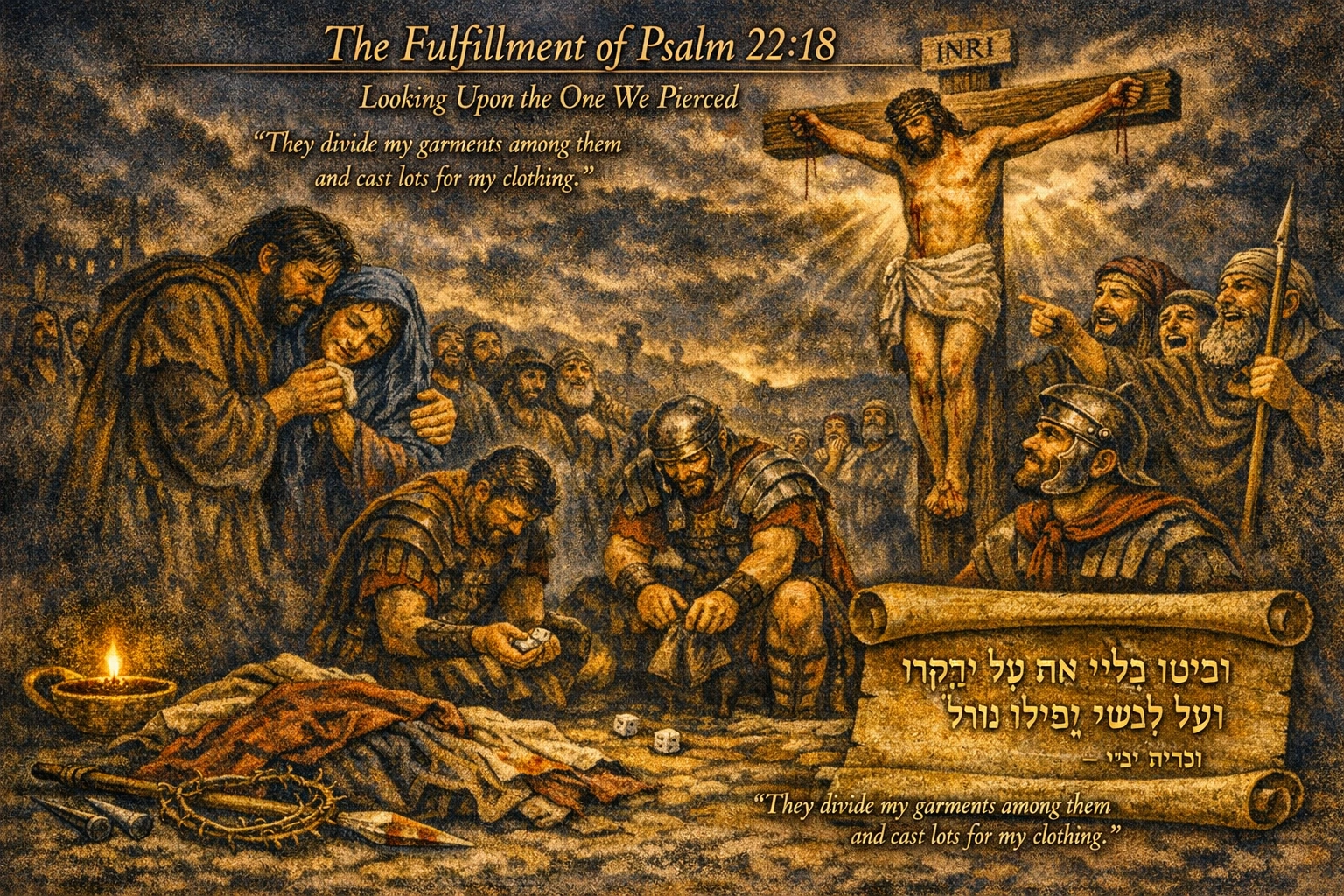
Week 12: The Fulfillment of Psalm 22:18
Week 12: The Fulfillment of Psalm 22:18
Throughout history, prophecy has helped God’s people recognise His hand at work. Prophecies act as divine signposts, pointing to future events while revealing God’s larger plan for humanity. One remarkable example appears in Psalm 22:18: “They divide my garments among them and cast lots for my clothing.” Though brief, this prophecy highlights the reliability of Scripture and the depth of God’s promises. Reflecting on it strengthens our confidence that God’s Word remains relevant, trustworthy, and full of hope for today.
Psalm 22 was written by King David centuries before Jesus’ birth. In verse 18, David describes a distressing scene: enemies dividing his garments and casting lots. At first glance, it may seem like a small detail within a larger picture of suffering. Yet its significance becomes clear in the New Testament. During Jesus’ crucifixion, recorded in all four Gospels, Roman soldiers divided His garments and cast lots for His seamless robe. This precise fulfilment shows the extraordinary foresight woven into Scripture.
Psalm 22 is often called a “messianic psalm” because of its striking parallels to Jesus’ suffering on the cross. Although David wrote from his own anguish, the Holy Spirit guided his words to point forward to the Messiah. By including such specific details, God ensured that the identity of the promised Saviour would be unmistakable. The fulfilment of this prophecy at Calvary powerfully demonstrates the unity of the Old and New Testaments and the divine authorship behind them.
Why does this matter today? First, fulfilled prophecy reveals God’s faithfulness. Every detail—large or small—matters in His plan. When we see even the smallest aspects of prophecy fulfilled, our trust in the accuracy and reliability of Scripture grows. The Bible is not a random collection of stories but a cohesive narrative orchestrated by God Himself.
Secondly, fulfilled prophecy strengthens our confidence in the promises that are still ahead. If God fulfilled His word concerning the Messiah’s suffering with such precision, we can trust Him to fulfil every other promise—to redeem, restore, and remain with His people. The events surrounding Jesus’ crucifixion were not accidental; they were foreseen and foretold, reminding us that God is sovereign over history.
Fulfilled prophecy also highlights God’s intentionality. Nothing escapes His notice, and nothing in His redemptive plan is accidental. The way Jesus’ crucifixion mirrored Psalm 22:18 shows that God works purposefully in all things. This brings comfort when we face uncertainty or suffering, knowing that God is always working behind the scenes.
If God was faithful to fulfil this prophecy about Jesus, we can be assured He is faithful in our lives as well. Sometimes God’s promises may seem distant or unclear. We may wait, question, or struggle to understand His timing. Yet just as the details of Jesus’ crucifixion were planned long beforehand, God is orchestrating the events of our lives with the same care and purpose.
Trusting God means believing He is at work even when we cannot see the outcome. It means holding onto His promises, no matter how unlikely they may appear. The fulfilment of Psalm 22:18 reminds us that God is attentive to both the big and small moments of our lives. When doubt creeps in, we can look back at fulfilled prophecy and see evidence of His unwavering faithfulness.
This prophecy also encourages us to approach Scripture with fresh eyes. Studying God’s Word and noticing how prophecy is fulfilled deepens our appreciation for His plan and strengthens our faith. We can rest assured that what God has spoken will come to pass in His perfect timing, just as it did for David and for Jesus.
Psalm 22:18 reminds us that God’s Word is true and His promises are reliable. Its fulfilment encourages us to trust Him more deeply, knowing He is always working for our good. As we reflect on the accuracy and significance of biblical prophecy, may we hold onto God’s promises with unwavering faith. The God who fulfilled every detail of His Word in the past will remain faithful in the present and the future. Let us trust Him with every aspect of our lives, confident that what He has spoken will come to pass in His perfect timing.
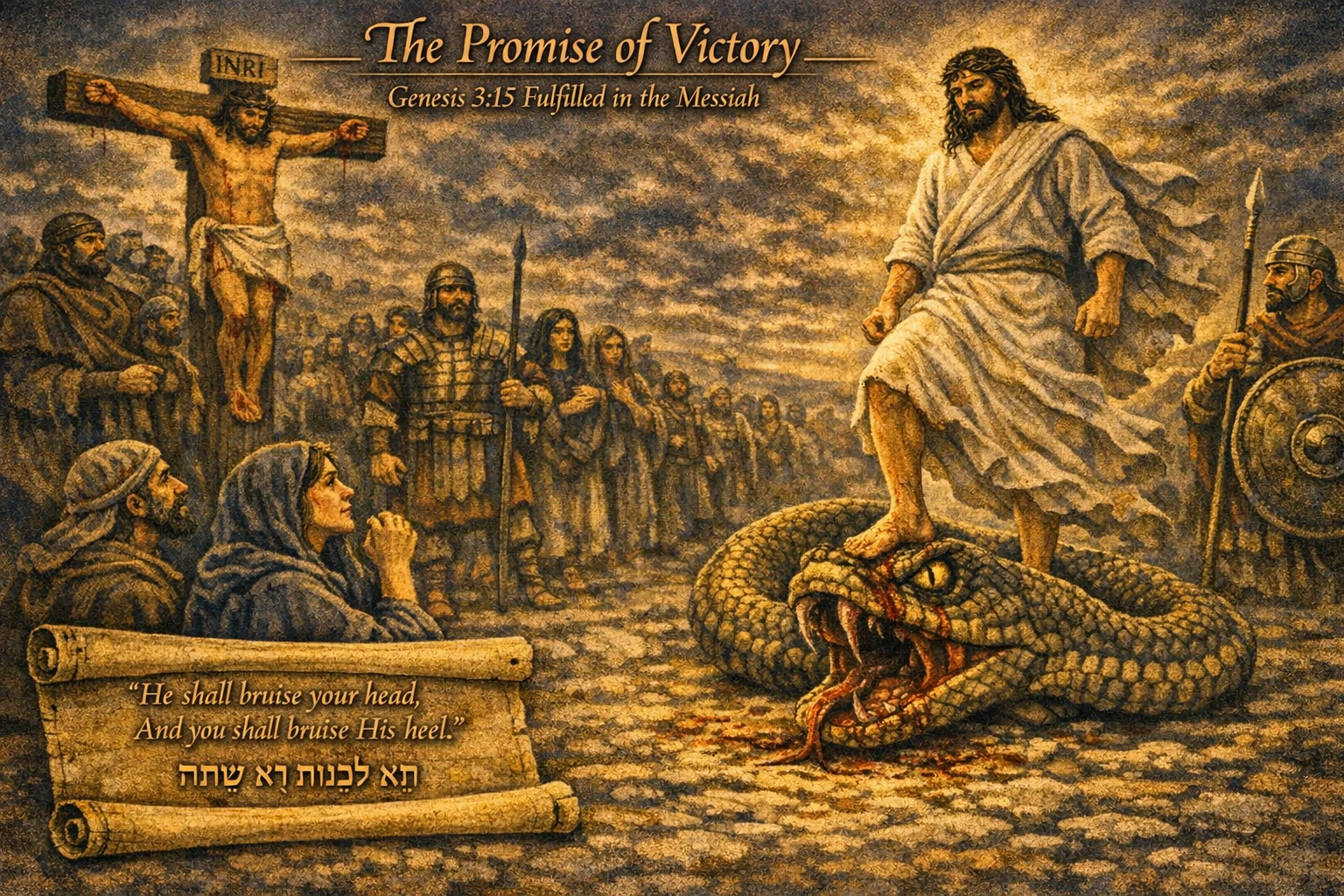
Week 13: The Promise Of Victorty
Week 13: The Promise Of Victorty
When people think of prophecy, they often picture the Old Testament prophets — Isaiah, Jeremiah, Ezekiel. But the very first prophecy in the Bible doesn’t come from a prophet at all. It comes from God Himself, spoken in the Garden of Eden, moments after sin entered the world.
And in that moment of heartbreak and loss, God does something extraordinary. He doesn’t leave humanity in despair. He speaks a promise — a promise that points directly to Jesus Christ.
The verse is Genesis 3:15:
“He shall bruise your head,
And you shall bruise His heel.”
This single sentence is the seed of the entire gospel. It’s the first whisper of Christmas, the first shadow of the cross, and the first announcement that evil will not win.
God is speaking to the serpent — the one who deceived Adam and Eve. But He’s also revealing His plan to rescue humanity.
He says there will be conflict between the serpent and the woman, between their offspring. But then the prophecy narrows to one Person:
“He shall bruise your head.”
A head‑blow — fatal, decisive, final.
“And you shall bruise His heel.”
A real wound, but not a lasting one.
This is the earliest prophecy of the Messiah.
It’s God saying:
And when we look at the New Testament, we see exactly how Jesus fulfilled this.
At the cross, Satan bruised Jesus’ heel.
Jesus was betrayed, beaten, mocked, crucified.
It was a real wound — physically, emotionally, spiritually.
But it was not the final word.
Because through that very suffering, Jesus delivered the head‑blow that Genesis 3:15 promised.
Through His death and resurrection, He broke the power of sin.
He defeated death.
He disarmed the enemy.
The serpent struck — but Christ crushed.
This is why Genesis 3:15 is often called the Protoevangelium — the first gospel.
It’s the moment God announced that Jesus would come, and that His victory would be complete.
This ancient prophecy isn’t just a theological detail. It speaks directly into our lives.
1. God speaks hope into our darkest moments
Genesis 3 is the lowest point in human history.
And yet God’s first words after judgment are words of hope.
Maybe you’re walking through something heavy right now — fear, guilt, uncertainty.
Genesis 3:15 reminds us that God never leaves us in our brokenness.
He moves toward us with a plan to restore.
2. God keeps His promises
This prophecy took thousands of years to be fulfilled.
But it was fulfilled — perfectly, completely, in Jesus.
If God kept this promise, the very first one He ever made, then we can trust Him with every promise He has made to us:
• His presence
• His forgiveness
• His guidance
• His return
• His victory
God is faithful. He does not forget His word.
3. The battle is real — but the victory is already won
We still feel the serpent’s bite — temptation, discouragement, spiritual struggle.
But the head of the serpent has been crushed.
We fight from victory, not for victory.
Christ has already won.
So how do we live in the light of Genesis 3:15?
• We cling to Christ when the enemy attacks
The serpent still bruises heels — but he cannot destroy those who belong to Jesus.
• We trust God’s timing
If God fulfilled a promise spoken at the dawn of time, He will fulfil the promises He has spoken over your life.
• We live with confidence
The story of the world — and the story of your life — is not heading toward defeat.
It’s heading toward victory, because Christ has already crushed the serpent’s head.
Genesis 3:15 is the first promise of a Saviour.
It points straight to Jesus — His suffering, His victory, and His triumph over evil.
And it reminds us that:
• God sees us
• God pursues us
• God rescues us
• God keeps His word
The serpent may bruise, but Christ has crushed.
And because of that, we can walk in hope, confidence, and peace.
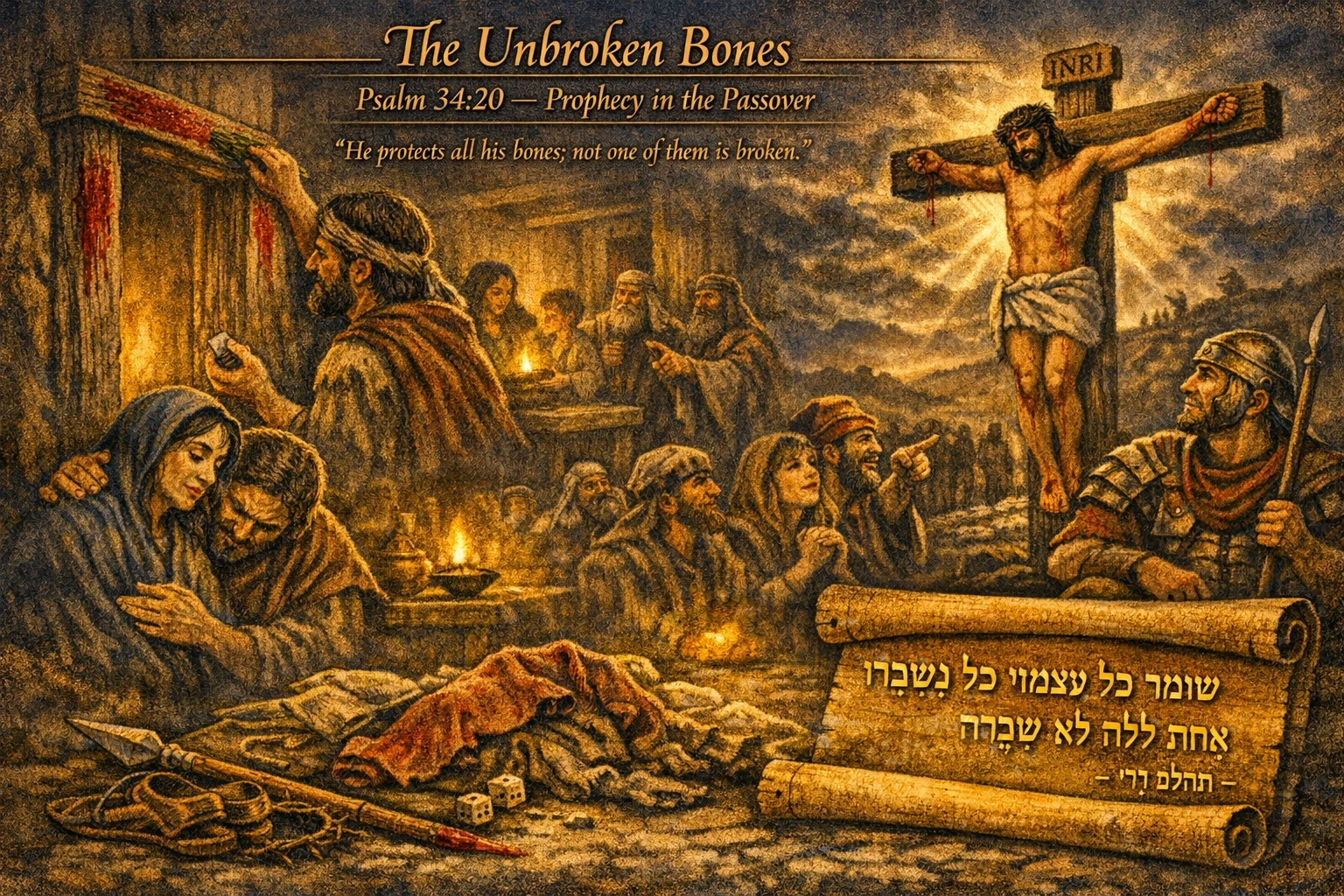
Session 14: The Unbroken Bones
Session 14: The Unbroken Bones
Tonight, I invite you to reflect on a single, striking verse from the Psalms: “He protects all his bones; not one of them will be broken” (Psalm 34:20). At first glance it may seem small, but as we explore its background, prophetic weight, and historical fulfilment, we’ll see that this verse is a thread woven through God’s faithfulness — stretching from ancient Israel to the cross, and into our lives today.
Psalm 34, attributed to David, is a psalm of thanksgiving and trust in God’s deliverance. David wrote it during a time of danger and uncertainty, yet he expressed confidence in the Lord’s protection. The promise that “none of his bones will be broken” symbolised not only physical safety but God’s meticulous care over those who trust Him. These words matter not just as history, but as hope for us now.
Centuries later, this verse found unexpected fulfilment in the death of Jesus. During crucifixion, Roman soldiers often broke the legs of the condemned to hasten death. But when they came to Jesus, they found He was already dead, and His legs were not broken (John 19:32–36). Scripture highlights this as a direct fulfilment of Psalm 34:20 — God’s promise kept in precise detail.
This is more than coincidence. It demonstrates that God’s word is utterly trustworthy. Theologically, it points to the perfection and integrity of Jesus as the Messiah. The unbroken bones are not just a medical observation; they signify that Jesus remained the unblemished sacrifice required for our redemption. Nothing in God’s plan was accidental or overlooked.
John’s Gospel makes this connection explicit, linking the event to prophecy and to the deeper meaning of Jesus’ sacrifice. The unbroken bones act as a signpost — pointing back to the Old Testament and forward to the hope we have in Christ.
To grasp the full weight of this, we look further back to the first Passover. In Exodus 12, God instructed Israel that the Passover lamb must be without blemish and that none of its bones were to be broken (Exodus 12:46; Numbers 9:12). This ritual, repeated annually, marked Israel’s deliverance from slavery and reminded them of God’s saving power.
The Passover lamb was a foreshadowing — a living picture of a greater deliverance to come. In the New Testament, Paul calls Jesus “our Passover Lamb” (1 Corinthians 5:7). The fact that none of Jesus’ bones were broken is therefore a profound theological statement: Jesus is the true and final Passover Lamb whose sacrifice brings freedom from sin and death. The unbroken bones underscore His purity, completeness, and the sufficiency of His offering.
This connection between prophecy and tradition is deliberate. It shows that God’s salvation plan has always been cohesive and fulfilled in Christ. Every Passover meal across generations was, in a sense, a rehearsal for the day when the true Lamb would give His life for the world.
So what does this mean for us today?
First, it reminds us that God keeps His promises — even the ones that seem small. We all know what it feels like to wonder whether God sees the details of our lives. Psalm 34:20 assures us that He does. If God ensured that not one bone of His Son was broken, how much more can we trust Him with our daily cares and uncertainties?
Second, the unbroken bones point to the perfection of Jesus’ sacrifice. Our hope rests not on a partial or flawed work, but on a finished, complete offering. We are made whole because Jesus, the unbroken Lamb, gave Himself fully for us.
Third, this truth calls us to live with trust and gratitude. Just as God worked through the details of history, He works in the details of our stories. We honour Him not only in dramatic moments of faith but in small, daily choices — trusting, obeying, and reflecting His love.
Finally, the Passover connection reminds us of our identity as people redeemed by grace. We are not defined by our brokenness, but by the wholeness Christ offers. As we reflect on the unbroken Lamb, we bring our flawed and fearful lives to the God who heals, restores, and makes all things new.
As we leave tonight, remember that God’s story is rich with meaning, even in details that seem small. The prophecy that “none of His bones would be broken” connects Jesus to the Passover lamb and stands as a testament to God’s faithfulness across generations. It assures us that His promises are sure, His plans are perfect, and His love for us is unbreakable.
May this lead us to trust Him more deeply, to look for His hand in every part of our lives, and to live as people who carry the hope of the unbroken Lamb into our world.
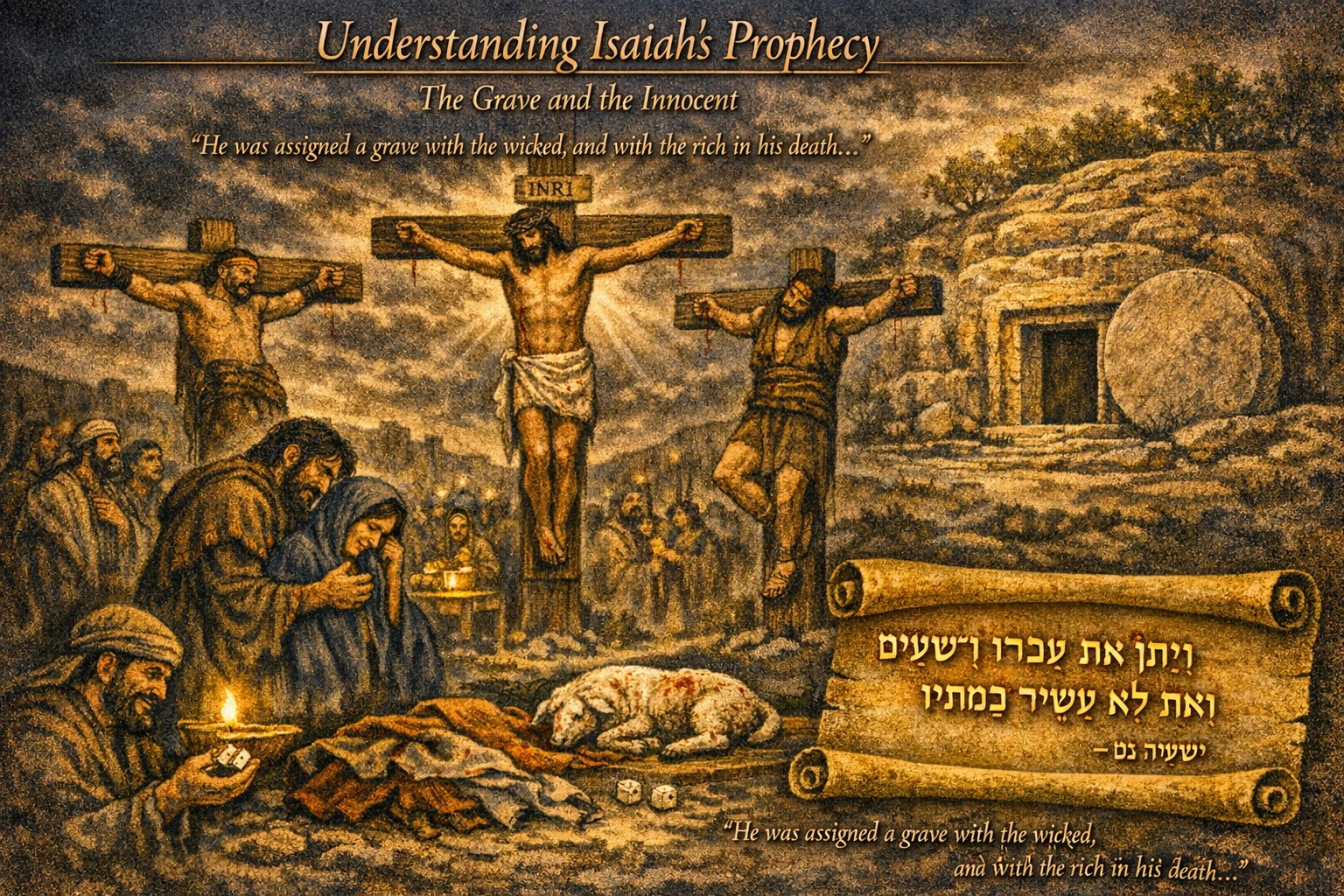
Session 15: The Grave, the Innocent, and Our Response
Session 15: The Grave, the Innocent, and Our Response
Today, I’d like to reflect on a profound verse from the Book of Isaiah: “He made His grave with the wicked and with the rich at His death, though He had done no violence nor was any deceit in His mouth” (Isaiah 53:9). This ancient prophecy speaks not only of the life and death of Jesus but also invites us to consider how innocence, suffering, and our own experiences intersect. As we reflect, let’s open our hearts to what this reveals about God’s character, the nature of justice, and our response as people of faith.
Isaiah wrote these words centuries before Jesus’ birth. The verse presents a striking paradox: though the servant of the Lord was innocent—having done no violence and spoken no deceit—He was assigned a grave among the wicked, yet buried with the rich. Historically, this finds fulfillment in the crucifixion and burial of Jesus. He was executed alongside criminals, sharing the fate of the wicked, yet His body was placed in the tomb of Joseph of Arimathea, a wealthy and respected man. This was highly unusual, as executed criminals were rarely given honourable burials.
This detail highlights both the reliability and divine inspiration of biblical prophecy. Isaiah’s words, written more than 700 years earlier, accurately describe events of the Passion. Such fulfillment invites us to trust not only the accuracy of Scripture but also the faithfulness of God to carry out His promises, even when circumstances seem bleak or confusing.
Isaiah’s words remind us that those who have done no wrong may still suffer injustice. Jesus embodied perfect goodness and truth, yet He was misunderstood, falsely accused, and punished as a criminal. This can be both comforting and challenging for us, especially when we or those we love face unfair treatment. It reminds us that suffering is not always the result of wrongdoing and that God sees and understands our pain.
There is comfort in knowing that when we experience injustice—false accusations, betrayal, or broader social wrongs—we are not alone. Jesus has walked this path. His empathy is not distant; it is rooted in lived experience. And His suffering was not meaningless. God used it to bring redemption to humanity, showing that our pain, too, can have purpose in His hands.
This perspective encourages us to view hardships not simply as misfortune but as opportunities for God’s grace to work through us. It also calls us to be mindful of others who suffer unfairly and to remember that their pain, like Jesus’, is seen and valued by God.
So how do we respond when we encounter injustice or witness innocence suffering? First, we take comfort in knowing that Jesus Himself experienced the deepest injustices and stands in solidarity with us. We can bring our pain, confusion, and frustration to Him in prayer, trusting that He understands and cares deeply.
Second, we are called to act justly, speak truthfully, and advocate for those who are mistreated. Scripture urges us to “seek justice, love mercy, and walk humbly with your God” (Micah 6:8). In our workplaces, families, and communities, we can be agents of compassion and fairness, following Jesus’ example. This may mean standing up for a colleague who is unfairly criticised, listening to someone who feels misunderstood, or supporting efforts that uplift the marginalized.
Living out these principles is not always easy. It may require courage to speak, humility to listen, and perseverance to pursue justice in the face of resistance. Yet as followers of Christ, we are empowered by the Holy Spirit to reflect His love and integrity, even in difficult circumstances. By doing so, we bear witness to the hope that God’s justice will ultimately prevail and help make our world more compassionate.
Isaiah’s prophecy reminds us that innocence does not guarantee a trouble‑free life. Yet through Jesus’ suffering, burial, and resurrection, we see that God can bring redemption out of the darkest circumstances. Let this passage encourage us to trust God’s justice, stand with those who suffer unfairly, and live lives marked by integrity and compassion.
As we leave today, may we remember that our response to injustice—both in our own lives and in the lives of others—matters. May we draw strength from Jesus’ example, seek to be people of truth and mercy, and trust that God’s purposes are at work even when they are hidden from view. Thank you for listening, and may God bless you as you live out these truths each day